


53% are willing to return, but a third have already chosen the EU: new sentiments among Ukrainian migrants
In the fifth year of full-scale war, forced migration is increasingly shifting from a temporary solution to a long-term life strategy. Despite maintaining an emotional connection to Ukraine, the decision regarding a possible return is increasingly based on pragmatic factors: safety, economic prospects, and stability. This is evidenced by the results of the third wave of a study on the factors influencing the return of Ukrainian migrants living in EU countries, conducted by Gradus in May 2026. Like the previous waves, the results of the third wave will be presented at the Ukraine Recovery Conference 2026.
Half of Temporary Migrants Still Intend to Return
After optimism rose to 68% in 2025, attitudes toward returning have shifted again. In 2026, 53% of Ukrainian migrants surveyed say they intend to return to Ukraine.
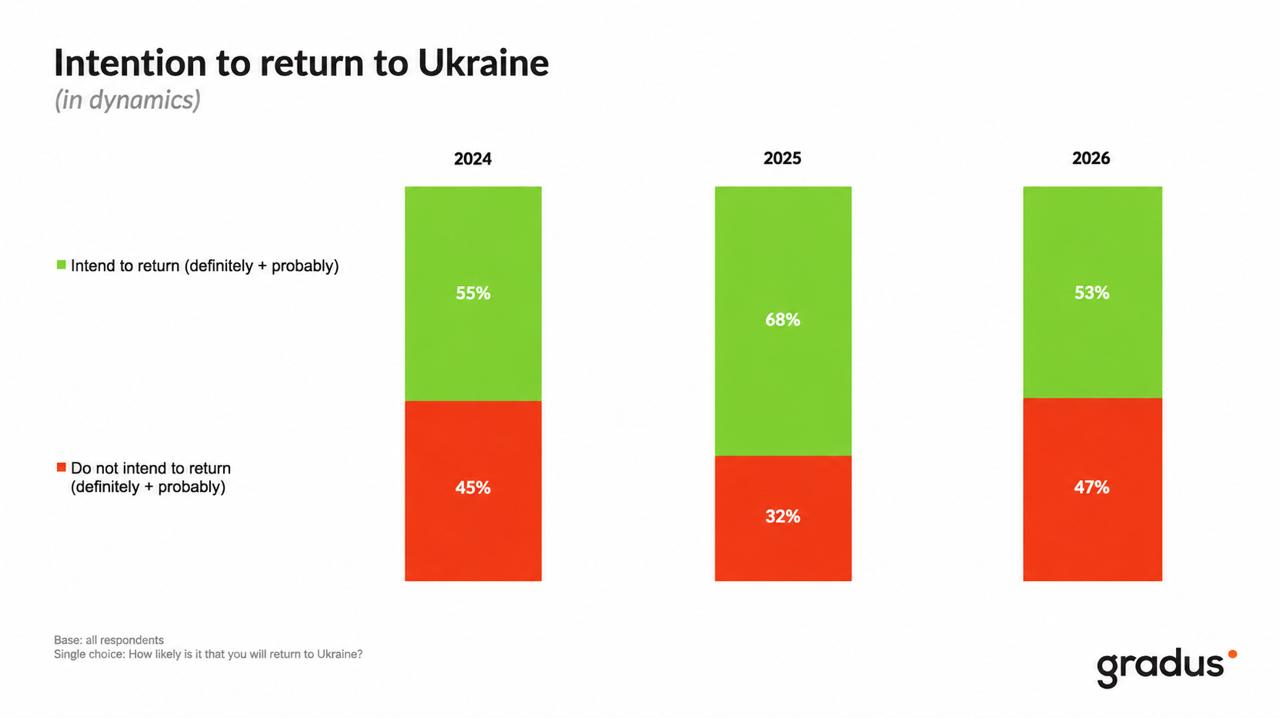
The proportion of those who no longer see their future in their homeland is growing noticeably. Even if the war ends on terms acceptable to Ukraine, 31% of those surveyed do not plan to return home. In 2025, this figure was only 13%. If the war ends on Russia’s terms, half of the respondents do not plan to return.
Calls to end the war and address domestic challenges
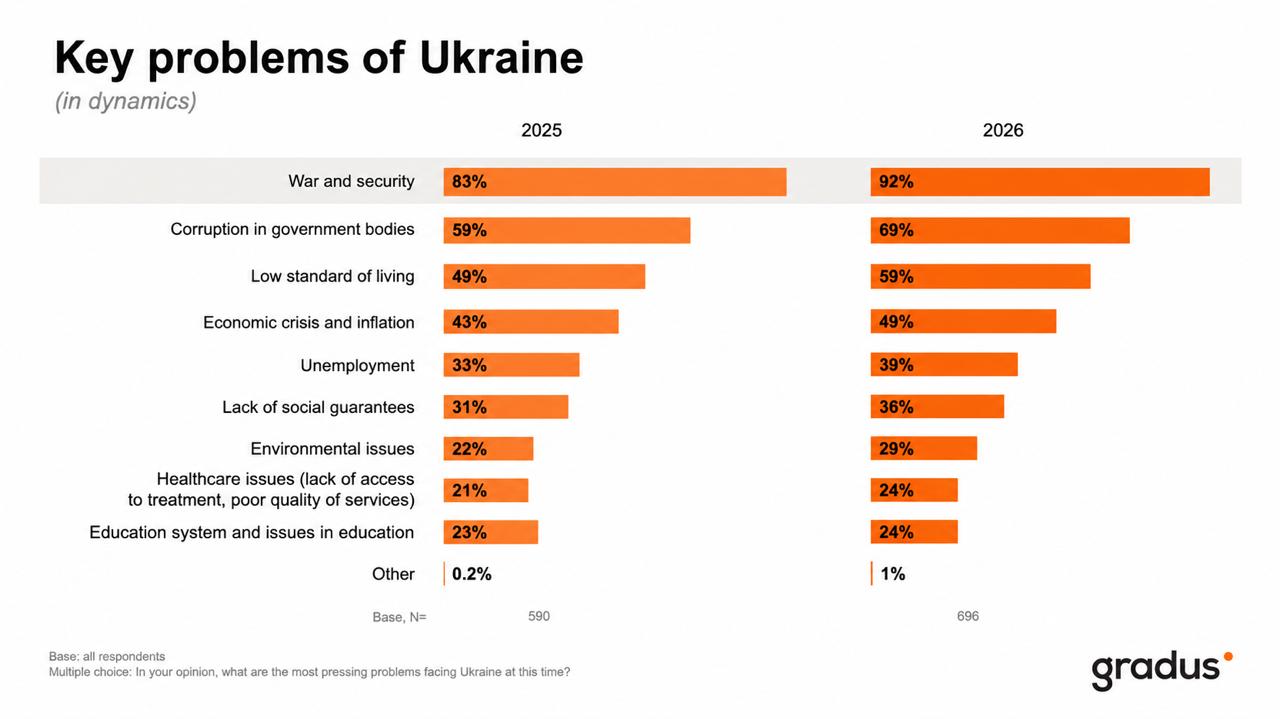
The war and security issues remain the main concerns for migrants—92% of respondents cite these as their primary concerns. At the same time, concern over the country’s domestic problems is becoming increasingly prominent: corruption (69%) and low living standards (59%).
Expectations regarding the duration of the war have also worsened. While in 2025, 35% of respondents believed that active hostilities would drag on for years to come, by 2026 that figure had risen to 46%. Against this backdrop, support for a negotiated end to the war is growing: 65% support achieving peace through negotiations.
The Timeline for Returning Is Shifting
Along with a decline in readiness to return, uncertainty regarding the timing of return is also growing. Two-thirds of respondents cannot say exactly when they are ready to return to Ukraine. Only 4% plan to return this year, and another 11% plan to return next year.
Even the end of hostilities is no longer seen as an automatic signal to return. Only 9% of respondents plan to return within the first month after the war ends. Most are considering a much longer period before making such a decision or have not yet decided on their plans.
Factors Influencing Future Migration Intentions
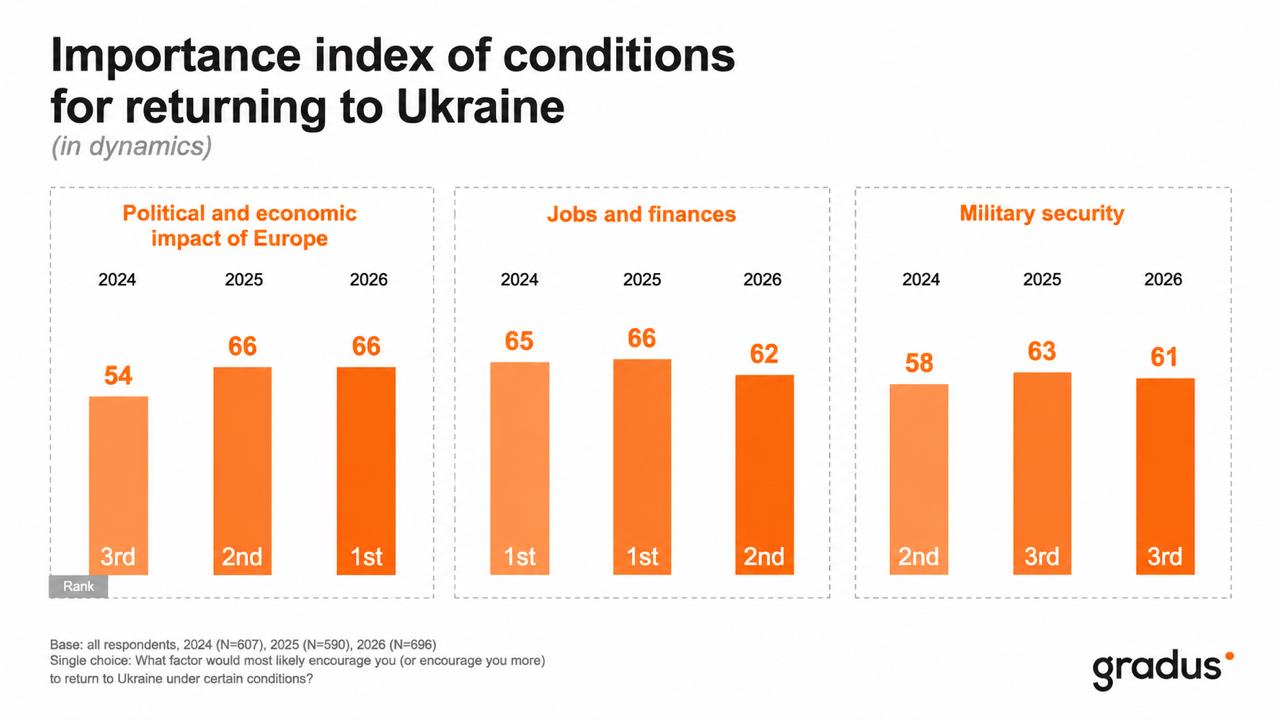
For the first time, changes in host countries—rather than developments in Ukraine—have come to the forefront among the key factors influencing return.
Respondents cite a potential reduction or cessation of support for Ukrainians in the EU or the end of the temporary protection regime as the strongest incentive to return. Only after these do the availability of work in Ukraine and security factors follow in terms of importance.
At the same time, the emotional connection to Ukraine remains very strong. The main personal motivations for returning are the desire to be close to family and friends.
Among the main reasons for staying abroad, respondents cite safety (86%) and the opportunity to provide a better life for themselves and their families (77%). Stability, freedom of movement and travel, and broader opportunities for professional fulfillment are also significant factors.
Separately, concern is growing about possible negative attitudes toward those who left during the war. While this factor worried 30% of respondents in 2025, it now concerns 53%.
The survey results indicate that for many Ukrainians in the EU, migration is no longer a temporary response to the war. As the years pass, people living abroad integrate into their new environment, build careers, form social connections, and plan for the future. Today, the key dilemma for a significant portion of Ukrainian migrants lies in choosing between a sense of belonging to Ukraine and the advantages of a stable and predictable life in their host countries. Consequently, the prospect of millions of refugees returning after the war ends will increasingly depend not only on the advent of peace, but also on how competitive living conditions in Ukraine will be,
— concludes sociologist, founder, and CEO of Gradus Yevheniia Blyzniuk.
The survey was conducted by the research company Gradus using a self-administered questionnaire in the Gradus mobile app. The target audience for the survey was Ukrainian migrants in EU countries aged 18–60. The fieldwork period was May 5–14, 2026. The sample size was 696 respondents.
Interesting


Catalog
Trending Headlines


