


Employees trust companies but do not recommend them: the eNPS for Ukrainian employers is -15
Employees in Ukraine trust their colleagues and management, but this does not translate into a willingness to recommend their employer to others. This was revealed by a study by Gradus. In particular, the employee loyalty index (eNPS) in our country remains in negative territory, and its level varies significantly by region.
Loyalty Index: More Employees Who Would Not Recommend the Company Than Those Who Would
How likely is an employee to recommend their company as a good place to work? Only 26% of surveyed employees are promoters—those most likely to do so. In contrast, 41% are detractors—that is, they are unlikely to recommend their company. Another 33% hold a neutral position. As a result, the eNPS (the difference between the proportion of promoters and detractors) stands at -15%.
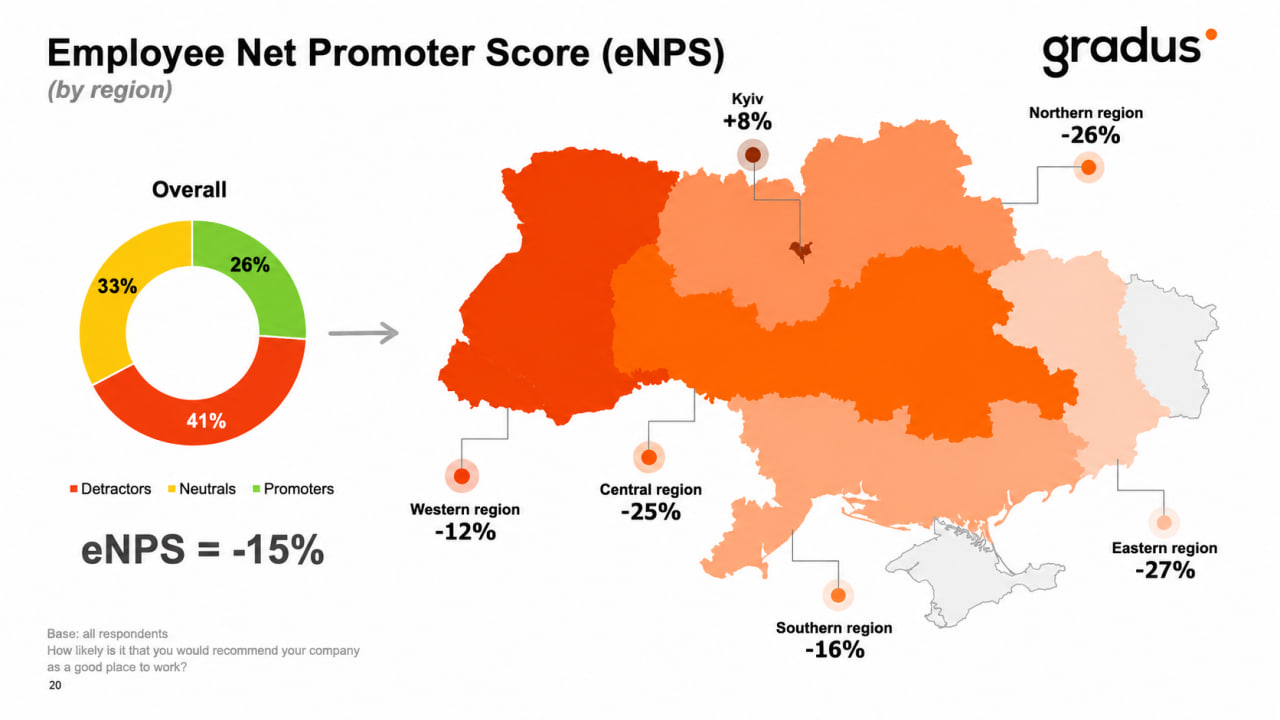
This metric appears contradictory given that, within teams working in Ukraine, trust generally remains high: 58% of respondents trust their colleagues, and 56% trust company leadership. In other words, low loyalty to the company is partially offset by strong internal support within teams, rather than satisfaction with the company as an employer overall.
Mental Health: A Zone of Silence That People Are Reluctant to Break
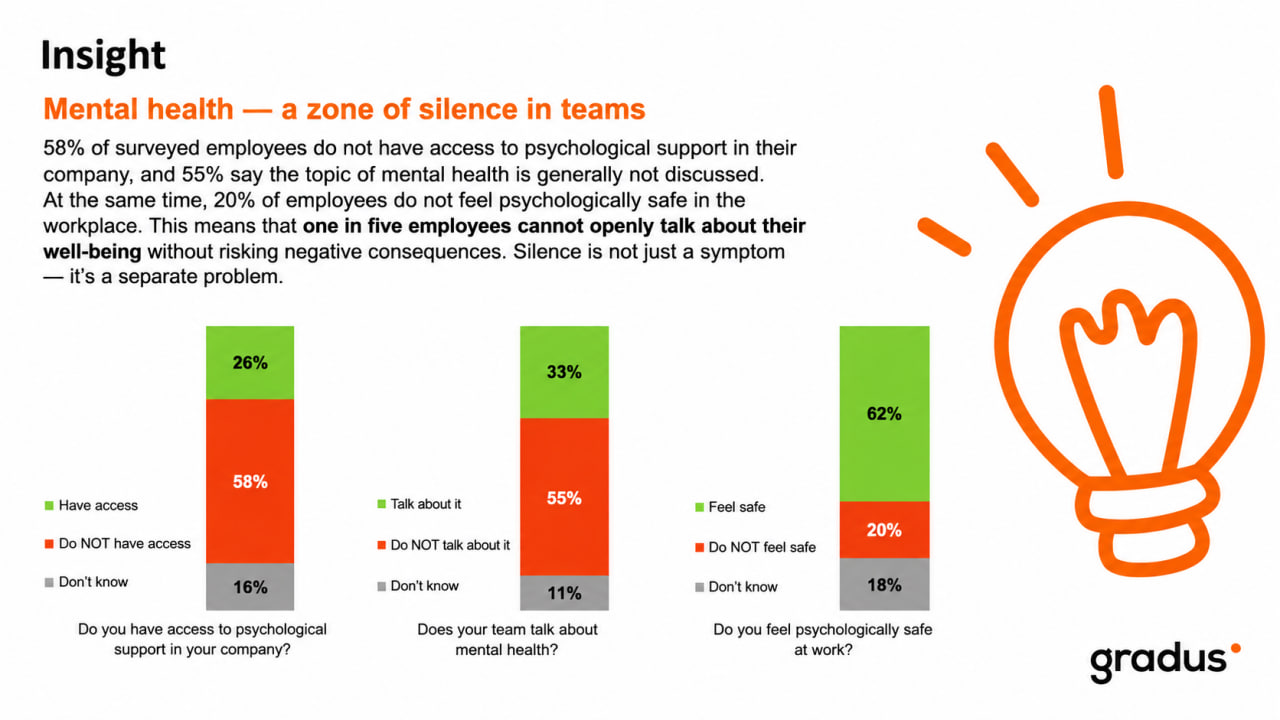
Only 16% of surveyed employees have access to psychological support at the company, while 58% report that such support is unavailable. Another 26% do not even know if such support is available. At the same time, one in five (20%) does not feel psychologically safe in the workplace—meaning they cannot openly discuss their mental state without risking negative consequences.
Together, these figures paint a clear picture: where there is neither support nor a sense of safety, the topic of mental health simply isn’t brought up, and this silence becomes a separate problem that exists alongside stress and burnout—that is, it is not a direct consequence of them.
In the context of war, when mental well-being is becoming an increasingly sensitive and important part of working life for Ukrainians, this very silence surrounding the topic of psychological support further undermines employees’ willingness to recommend the company as a good place to work.
What Employees Want from an “Ideal” Employer
The vision of an “ideal” organization remains quite pragmatic: fair compensation ranks first (63%), followed by a flexible work model (37%) and a positive and flexible work environment (35%).
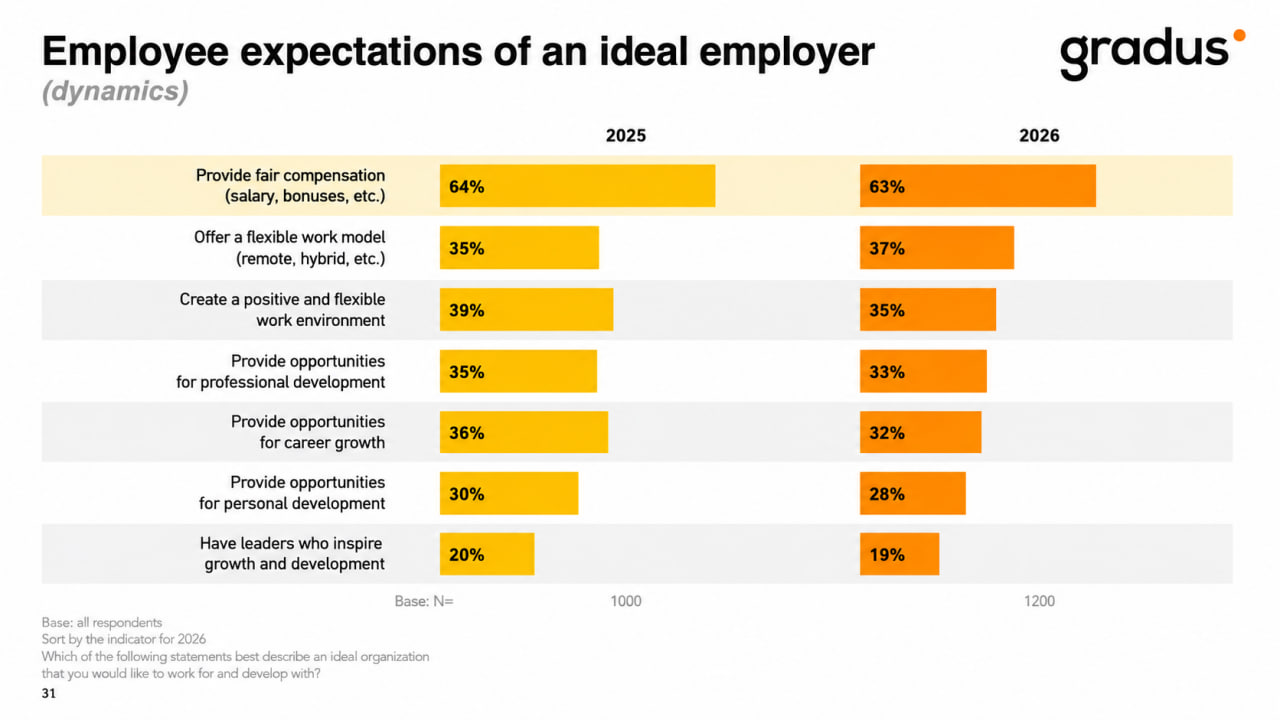
It is telling that, compared to the previous wave, the importance of nearly all the “inspiring” characteristics of an ideal employer—opportunities for professional development, career growth, and inspiring leaders—has declined, while the demand for work flexibility, on the contrary, has grown significantly. In other words, employees increasingly expect less active career support from companies and more basic stability and flexibility.
Understanding this shift in expectations gives employers a concrete guideline for building loyalty: it’s worth investing not so much in large-scale development programs as in things that directly impact the employee’s day-to-day experience.
Our research shows that employee loyalty in Ukraine today hinges on simple things: a manager they trust, the ability to speak openly about their well-being without fear of repercussions, fair compensation, and flexibility. Where there is greater trust in leadership, there is a greater willingness to recommend the company. At the same time, in companies where mental health remains a taboo subject, trust erodes silently, and HR only finds out about it once an employee has already submitted their resignation. For Ukrainians, psychological resilience is a matter of survival today, so employers who ignore this are gradually losing what is most valuable—trust—and, eventually, their employees,
— comments Yevheniia Blyzniuk, sociologist, founder, and CEO of Gradus.
The survey was conducted by Gradus using a self-administered questionnaire in the Gradus mobile app. The target audience consisted of men and women aged 18–60 who work full- or part-time and live in cities with a population of over 50,000 (excluding temporarily occupied territories and areas of active hostilities). Fieldwork period: March 10–31, 2026. Sample size: 1,200 respondents.
What Is eNPS and How Is It Calculated?
The Employee Net Promoter Score (eNPS) is an international metric used to assess employee loyalty to their employer. Its main goal is to understand how willing employees are to recommend the company as a good place to work to their friends, acquaintances, or colleagues.
The methodology is based on one simple question: “How likely are you to recommend your company as a place to work?” Employees rate their answer on a scale from 0 to 10.
Afterward, all responses are divided into three groups:
- Promoters (9–10 points) — actively recommend the company;
- Neutrals (7–8 points) — generally satisfied, but not ambassadors for the company;
- Detractors (0–6 points) — not willing to recommend their employer.
The eNPS score is calculated using the following formula:
eNPS = percentage of promoters (%) – percentage of detractors (%).
For example, if 50% of employees are promoters and 25% are detractors, then the eNPS is +25. If there are more detractors than promoters, the score becomes negative. This is precisely the situation observed in the Gradus study, where the average eNPS for Ukrainian companies is −15.
How to Interpret the eNPS
The eNPS itself does not have a universal “correct” value. It should be evaluated taking into account the industry, country, company size, and the dynamics of change. However, there are general benchmarks in international HR practice.
A score above +50 indicates a very high level of employee loyalty and a strong employer brand. A score between +20 and +50 is considered a good result, while a score between 0 and +20 is considered average, leaving room for improvement.
A negative eNPS means that there are more employees who are not willing to recommend the company than those who are. This does not necessarily indicate a crisis, but it is a signal for the HR team and management to investigate the causes of employee dissatisfaction more closely.
It is equally important to analyze this metric over time. If the eNPS increases following changes in corporate culture or HR policies, this indicates a positive effect even if the absolute value has not yet reached a high level.
What Most Influences eNPS
Employee loyalty is shaped not by a single factor, but by the cumulative daily experience of working at the company. According to international research and the practices of HR professionals, the factors that most influence an employee’s willingness to recommend their employer are the level of trust in leadership, fair compensation, the ability to openly express one’s opinion, and a sense of psychological safety.
Equally important are flexible work arrangements, work-life balance, clear internal communication, opportunities for professional development, and a culture of mutual respect within the team.
In times of high economic and psychological turbulence, stability and predictability are becoming increasingly important. That is why, for many employees today, fair rules, support from their manager, and a sense of security are more important than additional corporate bonuses.
How Companies Can Improve Their eNPS
Improving eNPS usually does not require expensive programs or large-scale reforms. It is far more important to systematically address the factors that influence employees’ day-to-day experiences.
One of the first steps could be conducting regular anonymous employee surveys, followed by an analysis of the causes of dissatisfaction. It is equally important to train managers in effective communication, as it is often the immediate manager who has the greatest influence on the level of trust within the team.
Developing psychological support programs, fostering a culture of open feedback, providing transparent explanations for management decisions, and regularly reviewing the compensation system in line with market conditions also yield positive results.
The best results are achieved by companies that do not view eNPS as a one-time metric but use it to continuously improve corporate culture and the employee experience.
Why eNPS Has Become One of the Key Metrics in HR
In recent years, eNPS has become one of the most widely used tools for assessing employee experience in international companies. It is used by both large corporations and small businesses due to the simplicity of the methodology and the ability to regularly track changes in team sentiment.
Unlike comprehensive employee engagement surveys, which can consist of dozens of questions, eNPS provides a quick and clear indicator of loyalty levels. This makes it a convenient tool for regular monitoring, comparing different departments, and evaluating the effectiveness of HR initiatives.
At the same time, experts emphasize that eNPS alone does not explain the reasons behind the results. This metric is most beneficial when combined with additional surveys, interviews, and analysis of corporate culture.
Conclusion
The results of the Gradus study show that today, an employer brand is defined not by high-profile HR projects or corporate bonuses, but by employees’ day-to-day experiences. Trust in management, the ability to speak openly about challenges, fair compensation, and flexible working conditions increasingly influence people’s willingness to recommend their company to others.
For employers, this means that building employee loyalty must be an ongoing process. Regularly measuring eNPS, paying close attention to feedback, and creating a safe work environment help not only reduce employee turnover but also build a strong employer brand, which becomes a competitive advantage in the labor market.
Interesting


Catalog
Trending Headlines


